If you’ve ever stood in the screen and hardware aisle trying to decode the label on a roll of mesh, you’re not alone. Fiberglass screen mesh is exactly what it sounds like — a woven fabric made from thin fiberglass strands, coated in vinyl, used to fill the open frames on a porch, lanai, or patio enclosure. It keeps insects out and lets air through. The rolls come in different widths (how wide the sheet is), weights (how heavy and dense the weave is, usually measured in ounces per square yard), and weave patterns (how tightly or openly the strands cross each other). Buy the wrong combination and you either run short, fight the mesh all day trying to get it into the spline channel, or end up with a porch that’s hazy and claustrophobic. Buy the right one and the whole re-screen goes cleanly. This guide gives you the decision framework to pick your roll before you’re standing at the checkout.
| EDITOR'S PICK[No-Seeum 20x20 Window Screen Me…](https://www.amazon.com/dp/B0DNNVDH27?tag=greenflower20-20) | Mid-tier[DOCA 48 in x 100 ft Window Scre…](https://www.amazon.com/dp/B075VDYPS1?tag=greenflower20-20) | Budget pick[DOCA 36 in x 100 ft Window Scre…](https://www.amazon.com/dp/B079YY5SJZ?tag=greenflower20-20) | |
|---|---|---|---|
| Width | 72 Inches | 48 Inches | 36 Inches |
| Weave Count | 20x20 | — | — |
| Insect Block | ✓ | — | — |
| Color | — | Charcoal | Charcoal |
| Price | $129.99 | $99.99 | $50.99 |
| See on Amazon → | See on Amazon → | See on Amazon → |
Why Width Is the Variable That Bites People First
The most common buying mistake — documented repeatedly in reader forums and echoed by This Old House’s guide to replacing window and door screens — is buying a roll that’s slightly narrower than the widest panel on the porch. You don’t realize it until you’ve already unrolled two feet.
Fiberglass mesh rolls come in standard widths: 24”, 36”, 48”, 60”, 72”, and 84”. Big-box stores reliably stock 36” and 48”. Anything above 60” is typically a special order or a specialty screen supplier.
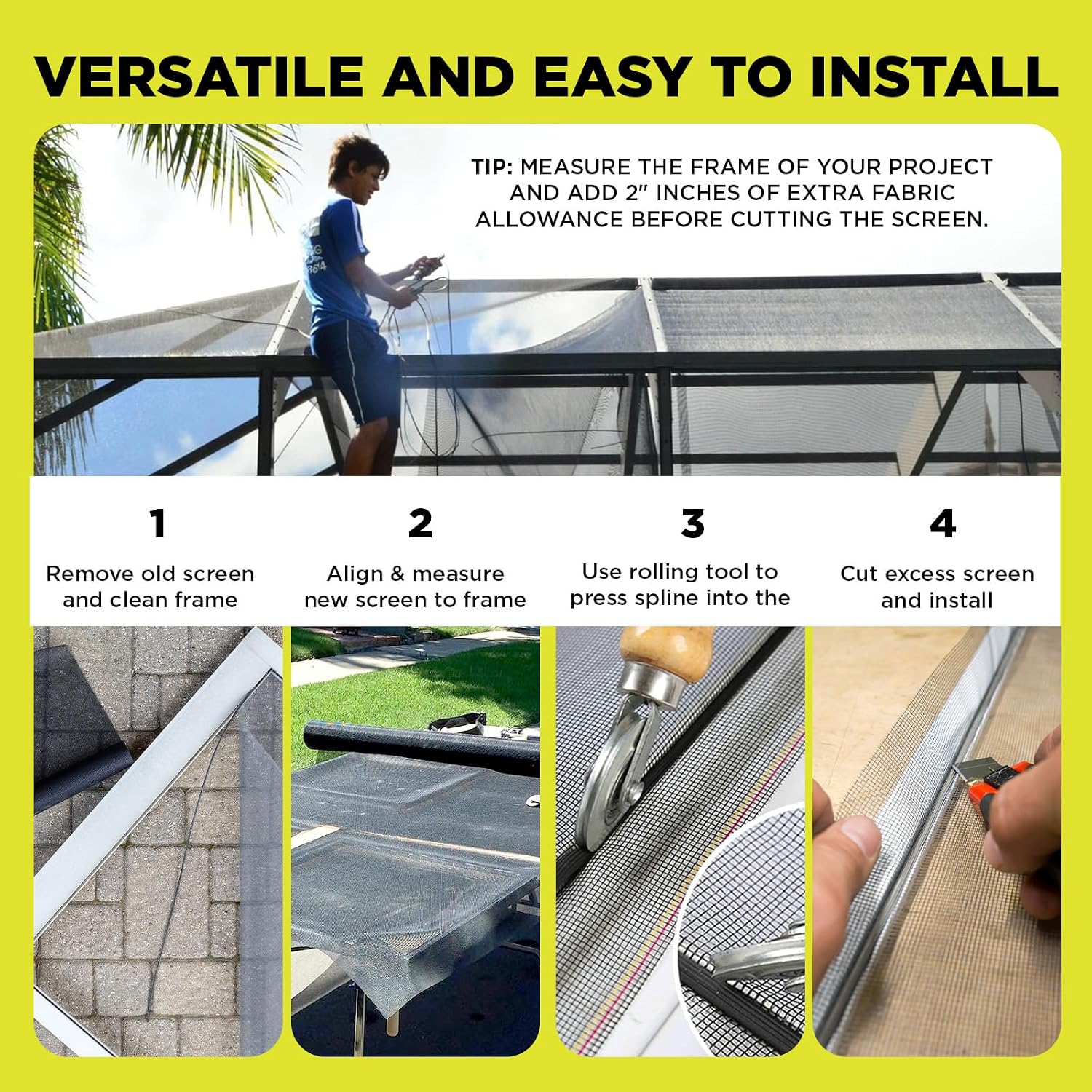
The rule: measure your widest frame opening (the clear span between spline channels, not the frame’s outer dimension), then buy the next width up. A 44” panel needs a 48” roll, not a 36”. Give yourself a 2” overhang on each side minimum — you need that excess to hold tension while you seat the spline.
Porch-specific reality: most residential porch bays run 36”–60” wide. A Florida-style aluminum screen enclosure with 4-foot panel bays is the most common re-screen scenario, and a 48” roll covers it cleanly. If you have a mix of panel widths — common in older wraparound porches — buy to your widest panel and plan to cut down for narrower ones. Waste on one panel beats a mid-project run back to the store.
Long runs: rolls typically come in 25-foot and 100-foot lengths. For a full porch re-screen, calculate total linear footage of all panels (panel height × number of panels), add 15% for waste and overlap, then choose the roll length that gets you there without a seam. Per the Family Handyman’s porch re-screening project guide, a standard 12’ × 16’ screened porch with 8 panels of approximately 72” height will burn roughly 55–60 linear feet of material from a 48” roll — a 100-foot roll covers it with room to correct mistakes.
Weight and Weave: The Tradeoff Grid You Actually Need
This is where buying decisions get nuanced, and where practitioners who’ve done a few jobs start developing strong opinions.
Standard mesh (18×16 weave, ~0.013” strand diameter): The industry baseline. The “18×16” refers to the number of strands per inch in each direction — 18 horizontal, 16 vertical. Phifer Incorporated’s Screen Products Specification Guide (the reference document most screen suppliers treat as authoritative) lists standard fiberglass mesh as having roughly 46–48% open area. That means nearly half the panel face is open air. Excellent airflow, good visibility, minimal solar shading. If your project is a typical residential porch in a four-season or mild climate where insects are the primary threat, standard 18×16 is the right answer. It’s easy to work with, widely available, and the spline seats cleanly.
Super screen / pet-resistant (17×20 or 20×20 weave, heavier strand): A denser weave with a thicker individual strand. Phifer’s BetterVue and similar lines from Saint-Gobain ADFORS use a finer-diameter strand at higher count to improve visibility while maintaining strength. True pet-resistant mesh uses a heavier strand diameter (.018”–.020”) that resists puncture from claws. The tradeoff is a meaningful reduction in open area — typically down to 32–38% — which reduces airflow and can make a smaller porch feel more enclosed. If you have dogs or cats that press against the screen, the heavier-strand products are worth it; if you don’t, you’re paying for weight you don’t need and giving up airflow.
Solar / privacy mesh (high-density weave, 5%–20% open factor): This is where fiberglass mesh starts overlapping with the solar-shade category. Products like Phifer’s SunTex 80 or 90 are technically woven fiberglass but engineered primarily to block solar radiation (80% or 90% blockage, respectively) and reduce visibility from outside. Open area drops to 10–20%. Airflow reduction is significant. These are appropriate for west-facing porches with harsh afternoon sun, for privacy-forward applications, or for a porch that doubles as a year-round sunroom. They require more care during installation — the stiff, dense weave doesn’t seat into spline channels as forgivingly as standard mesh. If you’re working with a Screeneze or similar aluminum channel system, confirm the spline width is spec’d for the heavier mesh before you buy.
By the Numbers: Standard Weave Comparison
| Mesh Type | Weave | Open Area | Typical Strand Dia. | Best For |
|---|---|---|---|---|
| Standard | 18×16 | ~46–48% | .013” | General insect control, max airflow |
| Super/BetterVue | 17×20 | ~38–40% | .013” | Clearer view, moderate strength |
| Pet-Resistant | 20×20 | ~32–36% | .018”–.020” | Homes with large dogs/cats |
| Solar/Privacy (SunTex 80) | High-density | ~18–20% | .020”+ | Sun control, privacy, year-round rooms |
Color, Coating, and the Visibility Equation
Fiberglass mesh is almost always PVC-coated — that vinyl coating is what gives the mesh its charcoal, gray, or black finish and protects the glass strand from UV degradation. The color choice is more functional than it appears.
Charcoal (dark gray/black): The near-universal recommendation for porches and enclosures. Charcoal mesh significantly reduces the “screen door effect” — the visual haze that makes it hard to see through a mesh cleanly. The dark strand absorbs light rather than reflecting it, so your eye effectively looks through rather than at the screen. This Old House’s guides on screen replacement consistently note that charcoal mesh provides meaningfully better outward visibility than silver or bright gray alternatives.
Silver/bright gray: Still sold and still installed, primarily because it’s cheaper per roll and more visible at the point of sale. The reflectivity works against you in practice — you’ll notice the screen more, particularly in outdoor light conditions. For a project where visibility matters (a porch with a view, a pool cage, a golf-course-facing lanai), charcoal is worth the modest price premium.
Fiberglass vs. aluminum: Worth naming because they’re sold side by side. Aluminum mesh is more rigid, more durable against pet damage, and slightly better for very high-wind coastal environments. The downsides: it creases permanently if bent during installation, it dents rather than flexes when impacted, and per Angi’s cost data on porch re-screening projects, aluminum mesh runs 20–35% higher per roll than comparable fiberglass. For most re-screen projects, fiberglass is the right default. Aluminum makes sense for coastal installations with persistent salt-air exposure, or when the contractor is specifying aluminum as part of a full aluminum enclosure system where material consistency matters.
Practical Buying Decision: The “If X, Then Y” Rules
You now have enough framework to make a clean decision. Here’s how to run it:
If your porch panels are 48” wide or narrower and you have no pets: A 48” roll of standard 18×16 charcoal fiberglass mesh in a 100-foot length is the workhorse choice. It’s stocked at every Home Depot and Lowe’s, priced at roughly $35–$55 per 25-foot roll (2026 pricing reflects modest material cost increases since 2024), and installs without drama.
If you have one or more large dogs that push against the screens: Upgrade to a pet-resistant product in the .018”–.020” strand category. Phifer’s Phiferglass Pet Screen is the most specified product in this category based on published contractor reviews; Saint-Gobain ADFORS carries a competing line. Expect to pay 40–60% more per roll and accept the airflow tradeoff.
If your project is a west- or south-facing porch with significant afternoon sun and you want a year-round room: Price the solar mesh category (SunTex 80 or equivalent) seriously. The open-area reduction to ~20% is real — do a visibility check at a supplier showroom before committing a full-enclosure order. Per Phifer’s published spec sheet, SunTex 90 blocks 90% of solar radiation while maintaining outward visibility; the mesh feels significantly denser than standard during installation and requires a larger-diameter spline in most frame systems.
If your panels are wider than 60”: Call a specialty screen supplier before ordering from a big-box source. Rolls above 60” are common in commercial and enclosure applications but are not stocked reliably at retail. Phifer, ADFORS, and regional enclosure distributors carry 72” and 84” rolls on standard lead times.
If you’re sourcing material for a contractor job with mixed panel widths: Buy one roll to the widest panel, cut down for narrower bays, and track your material by panel count rather than linear feet. Family Handyman’s re-screening guide recommends pre-cutting panels to rough length before starting the spline process to avoid wrestling a full roll mid-install.
The bottom line is that fiberglass screen mesh selection is a three-variable problem — width, weight, and weave — and each variable has a clear decision logic tied to your specific porch geometry, household, and climate. Standard 18×16 charcoal solves 70% of residential re-screen projects without debate. The remaining 30% are covered by moving up the weave density ladder with a specific reason: pets, solar gain, or a privacy priority. Buy to your widest panel, go charcoal unless there’s an explicit reason not to, and order the 100-foot roll if you have more than four panels to cover. The material cost difference between buying right the first time and a mid-project supplemental order almost always favors buying long upfront.