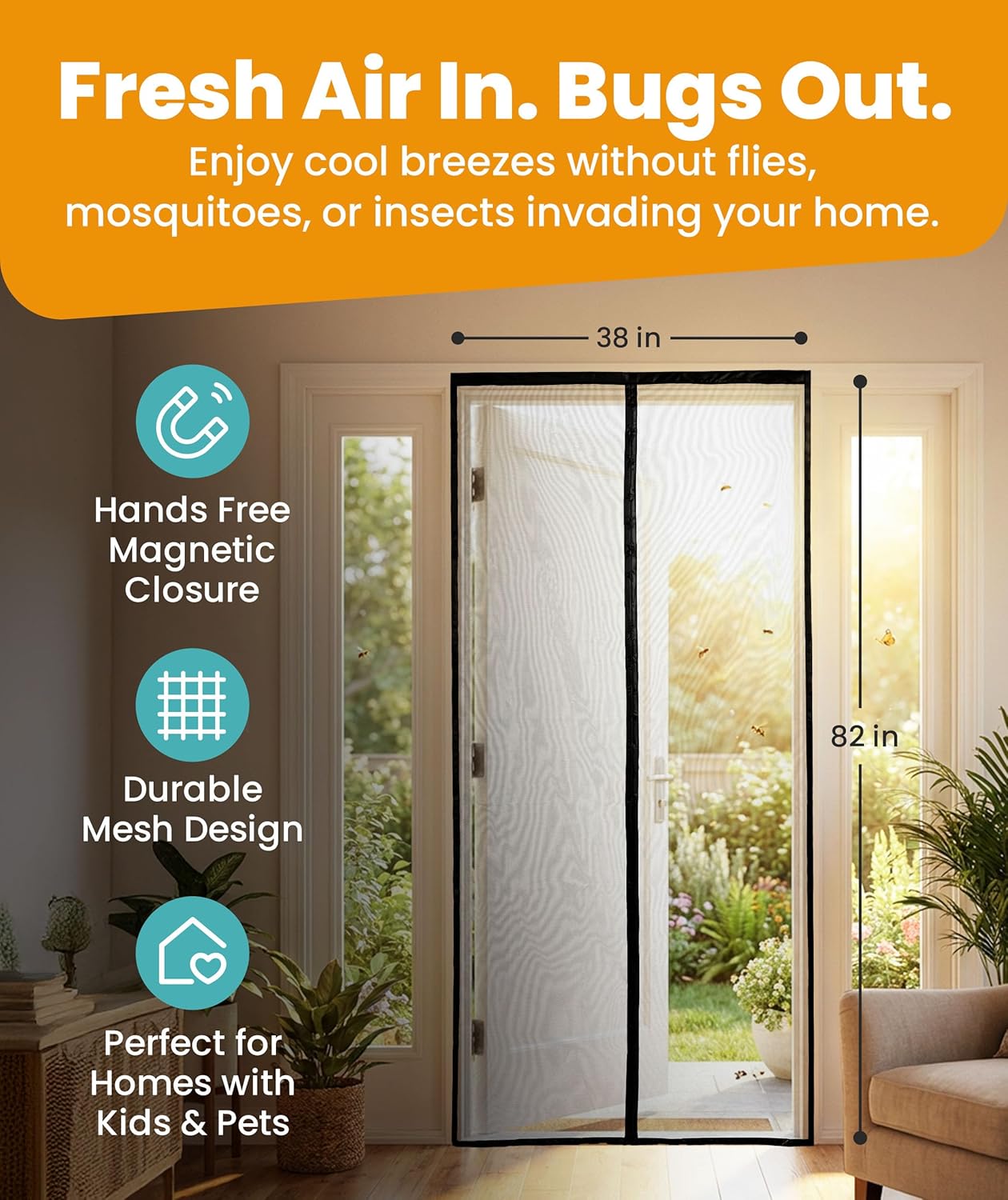
A magnetic screen door is exactly what it sounds like: a split curtain of mesh that hangs in a doorway and closes itself with a strip of magnets sewn down the center seam. The two panels meet in the middle, the magnets snap together, and — in theory — insects stay out while people and pets pass through hands-free. It’s an appealing concept, especially for a back door that sees constant in-and-out traffic during warm months. The problem is that this category spans a remarkable quality range, from sub-$10 mesh curtains that are essentially a novelty to genuinely well-built products in the $40–$90 range that hold up against wind, pets, and two or three seasons of daily use. If you’ve bought the cheap version and watched it fail, you already know the gap exists. This article gives you the framework to read a product listing and know — before you click “buy” — which side of that gap you’re looking at.
| EDITOR'S PICK[Fenestrelle Magnetic Screen Doo…](https://www.amazon.com/dp/B07C9HFJM2?tag=greenflower20-20) | Mid-tier[AUGO Magnetic Screen Door - Sel…](https://www.amazon.com/dp/B074TWKVQB?tag=greenflower20-20) | Budget pick[Flux Phenom Magnetic Screen Doo…](https://www.amazon.com/dp/B094PTPZM3?tag=greenflower20-20) | |
|---|---|---|---|
| Material | Fiberglass | Mesh | Mesh |
| Magnet Count | — | — | 52 |
| Screen Width | 70" x 80" | 38" x 83" | — |
| Pet Friendly | — | ✓ | ✓ |
| Price | $40.79 | $29.99 | $19.97 |
| See on Amazon → | See on Amazon → | See on Amazon → |
Why Most Magnetic Screen Doors Fail (And It’s Not the Magnets)
The magnet strip gets blamed for poor closure, but it’s rarely the root cause. Across aggregated reviews on major retail platforms, the failure modes cluster around three structural problems that show up long before the magnets degrade.
1. Mesh weight and weave density. Budget curtains use a lightweight polyester mesh — often described as “fiberglass-style” in listings, which is a stretch — with a loose weave that warps and bags after a few wash cycles or a week of wind exposure. Once the mesh loses its flat geometry, the two panels no longer meet evenly at the center seam, and the magnets can’t bridge the gap. This Old House’s guide to screen door materials notes that fiberglass mesh, properly woven at 18×16 threads per inch (the industry standard for insect screening), holds its shape significantly better than cheaper open-weave alternatives. On a magnetic door, mesh that holds its shape is non-negotiable, because the entire closure system depends on two flat panels aligning precisely.
2. Magnet count and placement. A magnetic screen door that uses six to eight magnets spaced widely down the center seam will billow open in any breeze above about 5 mph — the panels bow outward between magnet pairs, creating gaps that insects exploit immediately. The better products in the $40–$90 range use 26 or more individual magnets spaced roughly every two inches down the full seam length. That density matters more than magnet strength, because it eliminates the bow-out zones between attachment points.
3. Frame attachment system. Most budget curtains ship with thumbtacks or a handful of small push pins. Owners of these products consistently report that the curtain detaches from the door frame within days under normal traffic, because the attachment points can’t handle the lateral pull of someone walking through at an angle. Better products use hook-and-loop tape (the generic term for Velcro-style fasteners) running the full perimeter of the curtain, or a rigid rod-and-pocket top rail. The full-perimeter tape approach gives you a continuous anchor that doesn’t create weak points at the corners.
Reading a Product Listing Like a Practitioner
Here’s the practical skill: most magnetic screen door listings bury the specs that actually matter. Here’s what to look for, and what to ignore.
Look for:
- Magnet count stated explicitly. “26 magnets” or “magnets every 2 inches” is a meaningful spec. “Strong magnets” or “powerful magnetic closure” tells you nothing.
- Mesh thread count or gauge. The phrase “18×16 mesh” or “fiberglass reinforced” on a magnetic door indicates a denser, more stable weave. If the listing doesn’t state this at all, assume lightweight polyester.
- Full-perimeter attachment method. The listing should specify hook-and-loop tape along all four edges, not just the top. If it only mentions a header rod or “easy installation with thumbtacks,” expect corner failure.
- Stated door size range with overlap. A quality magnetic screen door should cover a standard 32”×80” or 36”×80” door with several inches of overlap on each side — typically 4–6 inches — so the curtain can be tensioned flat against the frame rather than hung loosely.
Ignore or discount:
- “Military grade mesh” — not a real specification in this product category.
- Weight in ounces as a quality signal — mesh weight and magnet count matter more than total product weight.
- Customer photos of the product installed; focus on reviews that describe long-term use (3+ months) rather than first-impression reactions.
Family Handyman’s installation tips for screen doors point out that door frame squareness matters enormously for any hung screen system. A door frame that’s out of square by more than ¼ inch will prevent a magnetic curtain from hanging flat regardless of product quality, because the two panels will never achieve a consistent gap at the center seam. Before you attribute closure failure to a cheap product, check the frame.
The Price Tiers, Honestly Mapped
By the Numbers
| Price Range | Typical Magnet Count | Attachment Method | Expected Lifespan |
|---|---|---|---|
| $8–$15 | 6–10 magnets | Thumbtacks / sparse push pins | 1 season (if lucky) |
| $18–$35 | 12–18 magnets | Partial hook-and-loop | 1–2 seasons |
| $40–$90 | 24–36 magnets | Full-perimeter hook-and-loop + rod | 2–4 seasons |
These ranges reflect what’s broadly available through major U.S. retailers as of mid-2026. The $40–$90 tier is where the product actually works as described; everything below that is a compromise you should go into with clear eyes.
The $8–$15 curtains are best understood as a temporary fix — a week-long camping setup, a seasonal cabin, or a stopgap while you wait for a proper storm door installation. Wirecutter’s overview of screen door options is blunt that budget mesh curtains in this category perform adequately only in low-traffic, low-wind conditions. If you have pets, children, or a door that sees more than 15 openings per day, this tier will frustrate you.
The $18–$35 middle tier is where most buyers get stuck. The products look almost identical to the premium tier in listing photos, and they represent most of the “recommended” picks in generic roundup articles that don’t account for use intensity. The partial hook-and-loop attachment means the curtain stays up through moderate use, but corner detachment is a common complaint in long-term owner reviews. If you’re a renter who wants to avoid drilling and will replace the product annually anyway, this is a defensible choice.
The $40–$90 tier is where the product works reliably. Owners in extended-use reviews consistently report that products in this range — characterized by 26+ magnets, full-perimeter hook-and-loop, and denser mesh — hold their closure under pet traffic and moderate wind. Consumer Reports’ buying guide for screen doors notes that closure reliability under sustained pet traffic is one of the hardest performance benchmarks for any screen door product to meet, and the $40–$90 magnetic curtains that hit it do so primarily through magnet density and attachment-tape continuity, not through any exotic material.
When a Magnetic Screen Door Is the Wrong Tool Entirely
This matters, and most buying guides skip it. There are installation contexts where even the best magnetic screen door will underperform, and recognizing them early saves you money and frustration.
High-wind exposure. If your back door opens onto a windy patio, deck, or open yard — particularly in coastal or Plains climates — the center seam will part in sustained winds above 10–12 mph regardless of magnet count. Magnetic closure works by bringing two panels together at the center; wind pushes them apart. A traditional hinged screen door with a spring-loaded closure and a latch wins in this environment without contest. Angi’s cost guide for screen door installation puts a basic hinged screen door installation at $150–$400 installed, which is the more honest investment for a high-wind opening.
Large dogs. Dogs above roughly 40 pounds hit a magnetic screen door with enough lateral force to separate even a high-magnet curtain on impact. The magnets re-close, but the repeated impact stress on the attachment tape eventually pulls the curtain off the frame. If you have a large or high-energy dog, a pet-specific magnetic door rated explicitly for dogs is a different product category — thicker mesh, reinforced seam, heavier magnets — and starts around $60–$80. Generic magnetic curtains are not pet doors.
Sliding glass door openings. Magnetic screen doors are sized and tensioned for standard hinged door frames — typically 32”–36” wide. A sliding glass door opening is often 60”–72” wide. Attempting to span that with a single magnetic curtain produces a heavy, sagging mesh that fails to close reliably at the center. This Old House’s screen door guide recommends retractable screen doors or purpose-built sliding screen systems for these openings — a different product category starting around $200 for DIY-installed retractable models.
The Decision Rule
Here’s where this lands as a clear if-then framework:
If your door is a standard hinged entry (32”–36” wide), the opening is protected from sustained wind, you don’t have large dogs, and your budget ceiling is $90 — then a magnetic screen door in the $40–$90 tier with 26+ magnets and full-perimeter hook-and-loop is a legitimate, functional solution that owners consistently rate as reliable across two or more seasons.
If any of those conditions isn’t met — high wind, large pets, wide sliding opening, or you need durability beyond two seasons — then you’re in hinged-screen-door or retractable-screen territory, and the $150–$400 installed cost is the realistic starting point, not a premium upsell.
If you’re sourcing for a rental property or a temporary setup where replacement cost matters more than longevity — then the $18–$35 middle tier is the honest call. Go in knowing you’ll replace it in a season.
The $9 curtain isn’t a bad product for its price; it’s a bad match for most of the situations people buy it for. Knowing which tier your situation actually calls for is the entire skill here — and now you have the framework to read a listing and make that call in under two minutes.
Installation note: Regardless of tier, measure your door frame before ordering. Most magnetic screen doors are sold in a “fits up to 36”×82"" format but require the customer to trim the curtain to their actual frame dimensions using scissors. If you skip the trim step, the excess mesh bunches at the bottom and prevents flat closure — a user-error failure that gets misattributed to product quality in a surprising number of reviews.