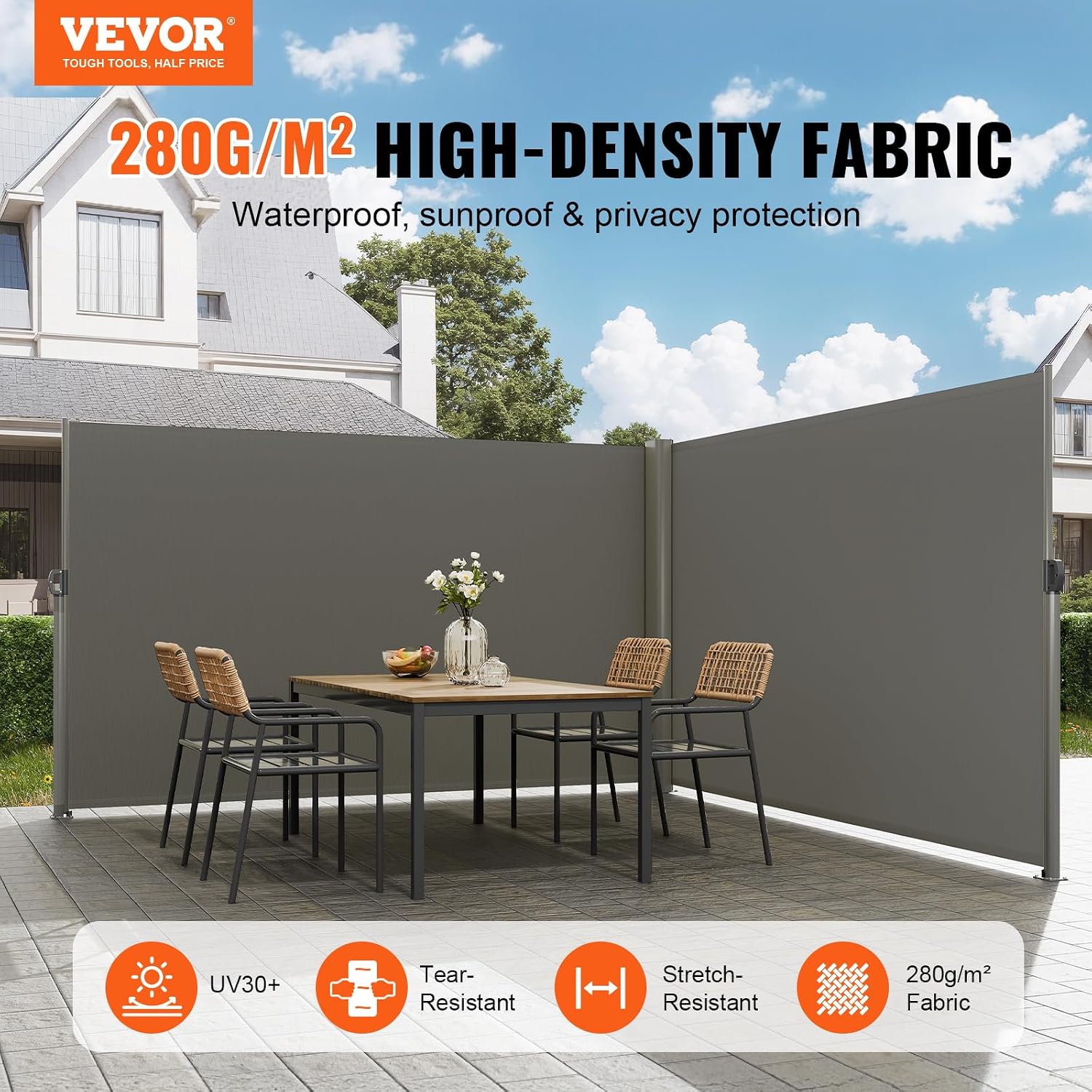
If you’ve started pricing retractable side awnings — the vertical fabric panels that roll or fold out from a wall, post, or overhead frame to block sightlines, wind, or late-afternoon sun — you’ve probably noticed that every spec sheet looks almost identical until you dig two layers deep. A “retractable side awning” is simply a vertically deployed screen that extends from a cassette (a housing that holds the rolled fabric) or a folding-arm mechanism, and retracts when you don’t need it. Unlike a fixed privacy fence or a permanent screen enclosure, these panels give you on-demand separation from neighbors, street traffic, or harsh light — which is exactly why they’ve become a serious line item on outdoor-living budgets. The challenge is that the specs sellers highlight — panel dimensions, color options, motor brand — are rarely the specs that determine whether you’re happy in year three. This guide breaks down fabric weight, weave openness, frame alloy grade, and the warranty language that signals a manufacturer’s actual confidence in their product.
Fabric Weight and Weave: The First Number That Actually Matters
Most retractable side awning panels are made from one of three fabric categories: acrylic-coated woven cloth (the classic awning material), PVC-coated polyester mesh, or HDPE (high-density polyethylene) shade cloth. Each behaves differently under load, UV exposure, and moisture — and each is rated differently, which is where comparison shopping gets complicated.
GSM (grams per square meter) is the standard weight measurement for awning fabrics, and it’s the single most honest proxy for durability at a glance. Published spec comparisons across major awning brands — Sunbrella, Dickson, and Sattler are the three most frequently cited in architectural specifications — show a consistent pattern: panels in the 200–300 GSM range (typical of residential acrylic-blend awning cloth) hold color and tensile strength better through UV cycling than lighter 150–180 GSM panels marketed as “commercial grade” based on thread count alone. Family Handyman’s overview of awning fabric specifications notes that GSM, combined with the fabric’s acrylic-versus-polyester base fiber, is the fastest way to filter out panels that will chalk (develop a faded white residue) or delaminate within three to five years in high-UV climates.
For privacy-specific applications — where you want to block sightlines, not just shade — the weave’s openness factor matters as much as weight. Openness factor is the percentage of a fabric’s surface area that is open to airflow and light transmission. A 3% openness factor means 3% of the panel is open; 97% is solid material. Here’s the tradeoff most sellers don’t explain clearly:
By the Numbers: Openness Factor vs. Privacy and Airflow
| Openness Factor | Privacy Level | Wind Load Tolerance | Typical Application |
|---|---|---|---|
| 1–3% | Near-opaque | Lower — panel acts like a sail | Sight-line blocking in mild-wind zones |
| 5–10% | High | Moderate — allows some air passage | Residential patio privacy, partial shade |
| 14–20% | Moderate | Higher — wind passes through | Solar shading priority, coastal/windy sites |
The practical implication: a 3% openness panel will give you the best visual privacy, but in a location with regular afternoon gusts above 15–20 mph, a low-openness panel catches wind like a sail and transfers enormous stress to the cassette mechanism and wall mounting hardware. This is why Bob Vila’s 2025 retractable awning review notes that installers in coastal Florida and Gulf Coast Texas routinely specify 10–14% openness panels even for “privacy screens,” accepting slightly reduced opacity in exchange for panels that retract safely under wind-sensor automation rather than tearing at the hem bar (the weighted horizontal bar at the panel’s bottom edge).
If you’re working in a low-wind inland setting and pure privacy is the goal, 3–5% openness with a 250+ GSM acrylic-coated fabric is the defensible spec. If wind is a regular factor, move to 10–14% and compensate with a darker color or a layered panel arrangement.
Frame Material: What “Aluminum” Actually Means on a Spec Sheet
Here’s the buried spec that separates a five-year product from a fifteen-year one: not all aluminum is the same alloy, and side awning sellers rarely publish alloy grade in their consumer-facing materials. The standard used in quality architectural hardware is 6063-T5 or 6061-T6 aluminum — these designations refer to the alloy composition and temper (hardening process), and they determine how much the frame can flex under lateral wind load before developing micro-cracks at welded joints.
Entry-level and mid-range side awning cassettes frequently use unspecified aluminum extrusions — listed simply as “aluminum frame” — that are likely 6060 or lower-temper variants. These are not dangerous, but owners consistently report that lower-temper cassette housings develop play (slight wobble) at the guide channels within two to four seasons in climates with significant thermal cycling (hot summers, cool winters). Architectural Digest’s overview of outdoor privacy screens flags this issue specifically for buyers in the Southwest, where temperature swings between morning and afternoon can exceed 40°F through spring and fall months.
What to ask before you commit:
- “What is the aluminum alloy grade and temper for the cassette and guide rail?” If the seller cannot answer or cannot produce a spec sheet, assume economy grade.
- “Are the guide rails continuous-extruded or assembled from shorter sections?” Continuous extrusions (single-piece rails running the full drop height) have no joints to loosen; assembled sections introduce failure points at each connector.
- “What is the cassette’s IP rating for weather resistance?” IP54 is a reasonable baseline for a cassette that will be permanently wall-mounted outdoors; IP44 (splash-resistant rather than dust-protected) is undersized for markets with regular afternoon thunderstorms.
For buyers sourcing in the $800–$2,000 range per panel — the bracket where motorized retractable side panels from brands like Weinor, Markilux, and MHZ (all distributed through specialty dealers in North America) live — continuous-extruded 6063-T5 cassettes with IP54 ratings are achievable and worth the premium. This Old House’s retractable awning buying guide consistently positions this specification tier as the inflection point where installer callbacks drop significantly.
The Motor and Drive System: Somfy Integration and the Spec Sellers Skip
If you’re adding motorization — and for side panels over 8 feet of drop height, manual operation becomes genuinely awkward — the motor specification affects both day-to-day usability and long-term smart-home integration. The dominant motor ecosystem for residential awning automation is Somfy, whose RTS (Radio Technology Somfy) and the newer io-homecontrol protocol are the two standards worth distinguishing.
RTS is Somfy’s original one-way radio protocol: the remote sends a command, the motor acts on it, but there’s no confirmation signal back to the hub or app. It’s reliable and the largest installed base in North America, but it doesn’t support true smart-home status feedback — you can trigger the panel from your phone, but your home automation system can’t confirm whether the panel is open or closed.
io-homecontrol is Somfy’s two-way protocol, introduced as their premium standard. It supports bidirectional communication, which means integration with platforms like Apple HomeKit (via the Somfy TaHoma hub), Amazon Alexa, and Google Home can include actual position confirmation. As of May 2026, Somfy’s TaHoma Switch hub supports io-homecontrol devices with native HomeKit certification — a meaningful upgrade from the previous-generation box that required a third-party bridge. For buyers planning a connected outdoor living room, specifying io-homecontrol motors from the start avoids the retrofit cost of replacing cassette-mounted motors later, which typically runs $200–$400 per panel in labor alone, per Angi’s 2025 awning installation cost data.
Wind and sun sensors — which automatically retract the panel when conditions exceed safe thresholds — are the other motorization spec that sellers underemphasize. Manufacturer-rated wind limits on the cassette mechanism (often 28–35 mph for a standard residential side panel) are the speed at which the motor will strain rather than the speed at which the fabric fails. If you’re in a zone with regular convective afternoon storms (most of Florida, coastal Texas, the Gulf states), a Somfy Eolis wind sensor or equivalent that triggers retraction at 18–22 mph gives you a meaningful margin of safety before you hit the cassette’s rated limit.
Warranty Language: The Three Clauses That Reveal Actual Confidence
The warranty is where manufacturer confidence — or the lack of it — is written in plain text, if you know what to look for.
1. Fabric vs. frame warranty split. Most awning warranties cover the frame and mechanism separately from the fabric, because fabric has a shorter rated life in UV-intensive climates. A well-structured warranty covers the frame for 5–10 years and the fabric for 3–5 years with explicit UV-fade provisions. Be wary of “5-year comprehensive warranty” language that doesn’t distinguish between components — it typically means 5 years on the frame and whatever minimum is legal for the fabric.
2. “Normal weathering” exclusions. This clause, present in most mid-range warranties, excludes color fading, chalking, and surface oxidation as “normal weathering not covered under defect warranty.” For acrylic-coated fabrics from Sunbrella or Dickson — which carry independent performance warranties against fading for 5 years — the manufacturer’s own fabric warranty may be stronger than the awning brand’s system warranty. Per ASTM D751 test standards for coated fabrics, a fabric warranty that specifies retention of a defined percentage of original tensile strength after accelerated UV exposure (rather than simply “will not fade excessively”) is a meaningfully higher standard than open-ended language.
3. Installation requirements as warranty conditions. Many premium awning warranties are conditionally voided if the cassette is not installed by a certified dealer or if wall anchoring doesn’t meet specified pull-out load ratings (typically 400–600 lbs per anchor point for a loaded side panel in wind). This is not unreasonable — an improperly anchored cassette is the most common failure mode — but it means DIY installation on a premium motorized panel is a real warranty risk. If DIY installation is your plan, this is an argument for mid-range fixed-guide-rail systems (like those from Eclipse or Spring USA’s commercial series) over cassette-based premium panels whose warranties require dealer certification.
If X, Then Y: The Decision Framework
You’re close enough to a decision that ambiguity costs you time. Here’s the honest filter:
If your site has consistent wind above 15 mph (coastal, elevated, or open-lot exposure): Specify 10–14% openness fabric, cassette with IP54 rating, and add a wind sensor to the motorization package. A 3% panel in this environment will either tear or require constant manual retraction — which defeats the purpose.
If privacy is the primary driver and wind is not a factor: 3–5% openness, 250+ GSM acrylic-coated fabric (Sunbrella or Dickson spec’d by name), continuous-extruded 6063-T5 frame. Don’t accept “aluminum frame” as a sufficient spec answer.
If you’re planning smart-home integration now or within five years: Specify io-homecontrol Somfy motors, not RTS. The upfront cost difference is modest (typically $80–$150 per motor); the retrofit cost if you change your mind is not.
If warranty coverage matters and you’re not using a certified installer: Choose a system whose warranty explicitly covers owner installation, or accept that you’re self-insuring the mechanism. Mid-range systems in the $400–$900 per panel range from brands like Coolaroo (for fabric-only panels) or Vita Patio (for framed cassette systems) typically have less restrictive installation requirements than premium European-market brands.
The specs sellers bury are rarely buried out of malice — they’re buried because most buyers don’t ask. You now have the questions.