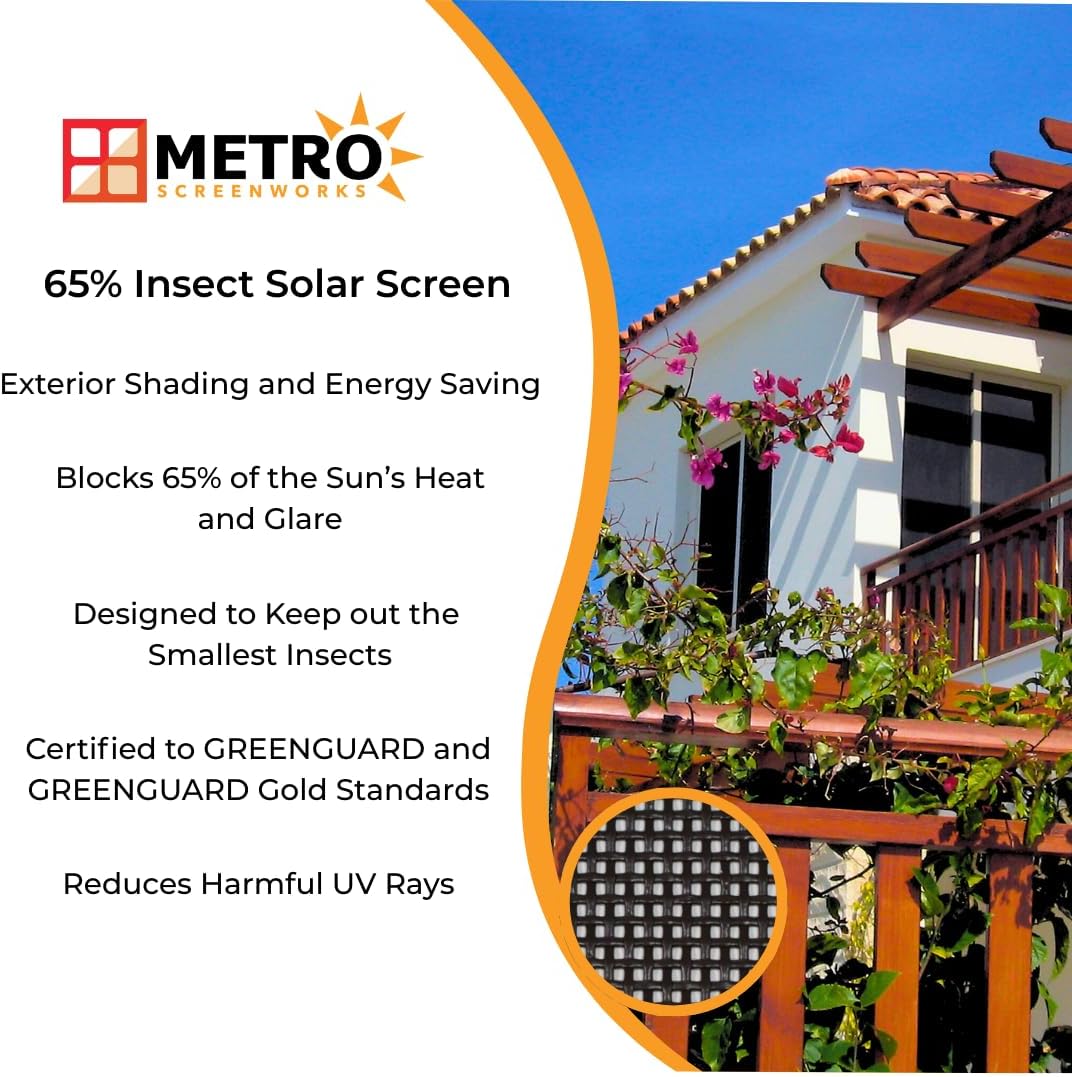
If you’ve ever stood in a showroom or scrolled a manufacturer’s site and seen a solar screen listed as “3% openness” or “10% openness,” you’ve encountered the single most important number in solar mesh selection — and probably gotten zero explanation of what it means. The openness factor (sometimes called the open area percentage) is simply a measure of how much of the mesh’s surface area is air — holes versus solid material. A 3% mesh has very small openings packed tightly together; a 14% mesh has larger, more widely spaced openings. That ratio controls three things simultaneously: how much solar heat enters your space, how clearly you can see through the screen, and how much visual privacy you get from the outside looking in. Get the number wrong and you’ll either roast in a “shaded” patio or feel like you’re staring at a wall from your favorite chair. This guide gives you the decision framework to match the right openness factor to your actual conditions — before the screen ships.
| EDITOR'S PICK[ADFORS Solar Screen](https://www.amazon.com/dp/B000CSK5G4?tag=greenflower20-20) | Mid-tier[Coolaroo 90% UV Block Heavy Dut…](https://www.amazon.com/dp/B0053G9UY8?tag=greenflower20-20) | Budget pickADFORS Solar Screen | |
|---|---|---|---|
| Dimensions | 48 in x 100 ft | 6 ft x 50 ft | 48 in x 84 in |
| Material | — | HDPE | — |
| UV Block | — | 90% | — |
| Tear-Resistant | — | ✓ | — |
| Roll Size Area | 400 sq ft | 300 sq ft | 28 sq ft |
| Price | $169.80 | $88.13 | $21.68 |
| See on Amazon → | See on Amazon → | See on Amazon → |
How the Openness Factor Is Measured (and Why Manufacturers Don’t All Agree)
The openness factor is expressed as the ratio of open area to total fabric area, stated as a percentage. A panel that is 95% solid fiber and 5% open space is a 5% openness factor mesh. Simple enough — but here’s where practitioners run into real disagreement.
The two dominant test standards are ASTM E2946 (the American standard for solar optical properties of window screens) and EN 14501 (the European standard used by many imported fabrics). The ASTM method measures fabric geometry only; the EN method factors in how yarn color and weave affect actual solar transmittance. This matters because two screens with identical openness factors but different yarn colors can reject meaningfully different amounts of heat. A dark charcoal 5% mesh will absorb and re-radiate more heat than a light bronze 5% mesh, even though both spec sheets list the same number.
Phifer Incorporated’s SunTex Solar Screen Technical Data Sheet (2025) makes this explicit: their SunTex 80 (approximately 5% openness, charcoal) and SunTex 90 (approximately 10% openness) differ not just in openness but in total solar energy rejected — 80% versus roughly 70% respectively — because yarn color compounds the openness effect. Twitchell Corporation’s Solar Mesh Openness Factor Performance Guide (2024) echoes this: they publish both the raw openness percentage and a separate SHGC (Solar Heat Gain Coefficient) value, because the two numbers together tell the real story that openness alone cannot.
The practitioner takeaway: When comparing meshes across brands, ask for the SHGC or total solar reflectance value alongside the openness factor. A low SHGC is what actually reduces your cooling load; openness factor is a reliable proxy within a single product line, but a shaky comparator across brands.
The View-Versus-Shading Tradeoff: A Straight Numbers Breakdown
This is where most homeowners get surprised after installation. The relationship between openness factor and view clarity is real but nonlinear — and lighting conditions flip the equation entirely.
By the numbers — typical performance bands across major product lines:
| Openness Factor | Solar Heat Rejection (approx.) | Daytime Outward View | Nighttime Privacy (interior lit) |
|---|---|---|---|
| 1–3% | Highest (85–90%+) | Very limited, dark/opaque | Excellent |
| 4–6% | High (75–85%) | Moderate, slightly dark | Good |
| 7–10% | Moderate (65–75%) | Clear, natural color rendering | Reduced — interior visible |
| 11–14% | Lower (50–65%) | Near-open clarity | Minimal |
Sources: Phifer SunTex Technical Data Sheet (2025); Koolshade/Twitchell Performance Guide (2024)
The column that most buyers underestimate is the last one: nighttime privacy. At night, when interior lighting is on, every solar mesh becomes more transparent from the outside regardless of its openness factor — because light always travels from the brighter side toward the darker side. A 5% mesh that gives excellent daytime privacy from street view will still allow neighbors to see silhouettes inside after dark if you have overhead lighting running. This Old House’s guide on solar shades specifically notes that privacy behavior reverses at night, a fact that regularly surprises first-time buyers.
For a pool cage or lanai where entertaining happens after sundown, this means a 3% mesh is doing meaningful work even when the sun is gone. For a home office with a western exposure that you vacate at 5 p.m., a 10% mesh may be the better call — prioritizing glare control during work hours and keeping the view open when you’re back for dinner.
How Openness Factor Connects to Your Actual Cooling Bill
Solar screens reduce cooling load, but quantifying that reduction requires understanding what “solar heat gain” means at the building level.
The Solar Heat Gain Coefficient (SHGC) is the fraction of incident solar radiation admitted through a window assembly — screen included — either directly transmitted or absorbed and later released inward. A bare single-pane window might have an SHGC of 0.86. Add a 5% charcoal solar mesh and that effective SHGC drops toward 0.35–0.45 depending on mesh color, orientation, and whether the screen is interior or exterior. The U.S. Department of Energy’s Energy Saver window attachments overview notes that exterior solar screens are significantly more effective than interior shades because they intercept heat before it enters the glazing assembly, preventing the “greenhouse trap” that interior shades can create.
The ENERGY STAR residential windows specification framework uses SHGC thresholds by climate zone: for the hot-humid South (ENERGY STAR Zone 3, covering most of Florida and coastal Texas), ENERGY STAR targets an SHGC ≤ 0.25 for windows as a fixed unit. A well-specified exterior solar mesh on an existing window can move a non-compliant window meaningfully closer to that zone target — relevant to homeowners in Florida counties where the 2023 Florida Building Code (Chapter 26, Table R402.1.2) requires compliance documentation on permitted additions including screen enclosures.
The practical math for a mid-size project: A typical 12×16 lanai addition in central Florida with four screened bays of western exposure might see 200–250 sq ft of solar mesh facing peak afternoon sun. Switching from bare screen (openness factor ~30–40% on standard fiberglass insect screen) to a 5% solar mesh could reduce that room’s afternoon cooling load by an estimated 40–55%, per published SHGC delta data from Phifer. At a conservative Florida residential electricity rate of roughly $0.13–$0.14/kWh (2026 mid-year average), that doesn’t move the whole-home bill dramatically in isolation — but for a conditioned Florida room or a space with a dedicated mini-split, owners consistently report noticeable monthly savings, and the comfort improvement (reduced radiant heat off screened walls) is the more immediately felt benefit.
Region, Orientation, and Use Case: Matching the Number to Your Conditions
The openness factor that’s ideal for a shaded north-facing porch in Atlanta is wrong for a southwest-facing pool cage in Phoenix. Here’s the decision framework:
If your primary driver is heat rejection and you’re in a Sunbelt climate (Florida, Texas, Arizona, coastal Carolinas): Choose 3–5% openness, charcoal or black yarn. The low openness maximizes solar blockage; dark yarn absorbs and dissipates heat at the screen surface rather than transmitting it. The view sacrifice is real but manageable — owners consistently describe it as “looking through sunglasses” rather than looking through a wall, particularly from inside on a bright day.
If your primary driver is view preservation (lake view, landscape investment, designed outdoor room): Choose 10–14% openness, bronze or beige yarn if privacy is secondary. Lighter yarn improves color rendering outward. Understand that you’re accepting roughly 50–65% solar heat rejection — meaningful, but not maximum. For high-value properties where the view is a core design asset, this is the right tradeoff, and it’s the tier where motorized retractable systems (Phantom Screens, Mirage Screens, Lifestyle Screens) earn their cost premium: retract fully on overcast days, deploy at solar noon, and calibrate to conditions rather than committing to a fixed panel.
If your primary driver is privacy without sacrificing too much view: The 5–7% range is the workhorse band. You get strong daytime privacy from street level, reasonable heat rejection, and a view that remains identifiable rather than obscured. Most contractor-specified fixed-frame lanai conversions in Florida and Texas default to this range for exactly this reason.
If you’re in a temperate climate with only 3–4 peak-heat months: A 10% mesh gives you year-round view and reasonable seasonal shading without the dark-interior feel of a 3% mesh during your long mild season. The cooling-bill math favors the better view here because the high-solar-load window is shorter.
One variable that overrides almost everything: orientation. A north-facing porch in any U.S. climate receives almost no direct solar gain regardless of mesh. Specifying a 3% mesh there to “maximize cooling” costs you view and light for no functional benefit. Always establish compass orientation before selecting openness factor — it’s the first question a competent screen dealer should ask.
The Decision Rule
If you’re currently under contract on a patio enclosure, lanai conversion, or motorized system and need to lock in a mesh spec, run this sequence:
-
Identify your primary facing exposure. North-facing: openness factor is flexible; lean toward 10%+. South, west, or southwest: openness factor is the primary lever; lean toward 3–7%.
-
Identify your primary use case. Daytime occupancy in sun (home office, dining): prioritize heat rejection (3–5%). Evening/nighttime entertaining: consider that privacy reverses at night — a 5% mesh adds little after dark, so if night privacy matters, pair with solid or opaque privacy panels at key sightlines.
-
Ask your supplier for SHGC, not just openness factor. If they can only give you openness, compare within a single product line (Phifer-to-Phifer, Twitchell-to-Twitchell) where the number is a reliable proxy.
-
If the view is a major design value, budget for retractable. Fixed mesh commits you permanently to a single tradeoff. Motorized systems eliminate the tradeoff by letting you choose in real time — and for projects in the $2,000–$5,000+ range, the amortized cost-per-use math increasingly favors the upgrade.
The openness factor number is small, but it’s carrying enormous weight. Get it anchored to your orientation, your hours of use, and your climate before the order goes in — changing it after installation means replacing the mesh entirely.